 Add to Chrome
 Add to Firefox
 Add to Edge
Scalable neural pushbroom architectures for real-time denoising of hyperspectral images onboard satellites
Jan 08, 2026
The next generation of Earth observation satellites will seek to deploy intelligent models directly onboard the payload in order to minimize the latency incurred by the transmission and processing chain of the ground segment, for time-critical applications. Designing neural architectures for onboard execution, particularly for satellite-based hyperspectral imagers, poses novel challenges due to the unique constraints of this environment and imaging system that are largely unexplored by the traditional computer vision literature. In this paper, we show that this setting requires addressing three competing objectives, namely high-quality inference with low complexity, dynamic power scalability and fault tolerance. We focus on the problem of hyperspectral image denoising, which is a critical task to enable effective downstream inference, and highlights the constraints of the onboard processing scenario. We propose a neural network design that addresses the three aforementioned objectives with several novel contributions. In particular, we propose a mixture of denoisers that can be resilient to radiation-induced faults as well as allowing for time-varying power scaling. Moreover, each denoiser employs an innovative architecture where an image is processed line-by-line in a causal way, with a memory of past lines, in order to match the acquisition process of pushbroom hyperspectral sensors and greatly limit memory requirements. We show that the proposed architecture can run in real-time, i.e., process one line in the time it takes to acquire the next one, on low-power hardware and provide competitive denoising quality with respect to significantly more complex state-of-the-art models. We also show that the power scalability and fault tolerance objectives provide a design space with multiple tradeoffs between those properties and denoising quality.

A low-complexity method for efficient depth-guided image deblurring
Jan 07, 2026Image deblurring is a challenging problem in imaging due to its highly ill-posed nature. Deep learning models have shown great success in tackling this problem but the quest for the best image quality has brought their computational complexity up, making them impractical on anything but powerful servers. Meanwhile, recent works have shown that mobile Lidars can provide complementary information in the form of depth maps that enhance deblurring quality. In this paper, we introduce a novel low-complexity neural network for depth-guided image deblurring. We show that the use of the wavelet transform to separate structural details and reduce spatial redundancy as well as efficient feature conditioning on the depth information are essential ingredients in developing a low-complexity model. Experimental results show competitive image quality against recent state-of-the-art models while reducing complexity by up to two orders of magnitude.
Deep Lidar-guided Image Deblurring
Dec 10, 2024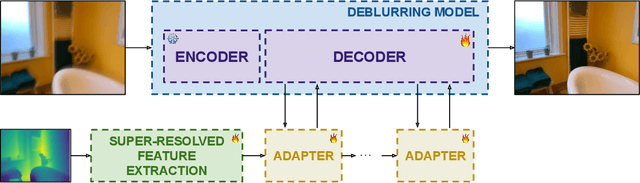
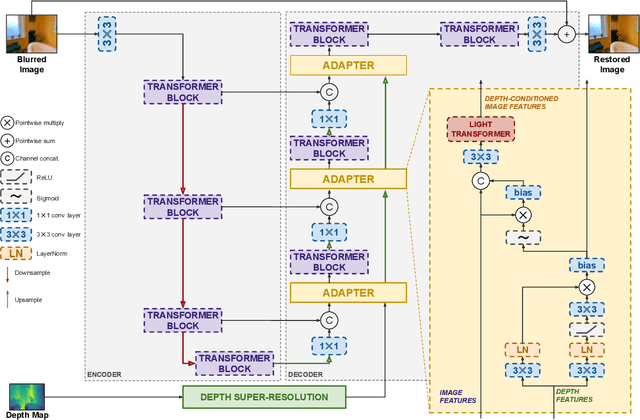
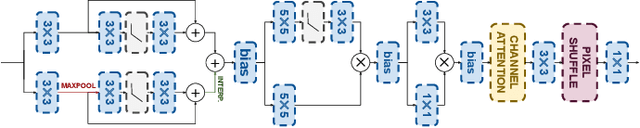
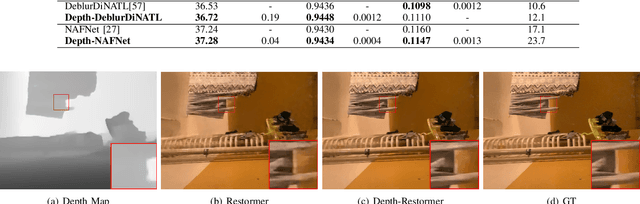
The rise of portable Lidar instruments, including their adoption in smartphones, opens the door to novel computational imaging techniques. Being an active sensing instrument, Lidar can provide complementary data to passive optical sensors, particularly in situations like low-light imaging where motion blur can affect photos. In this paper, we study if the depth information provided by mobile Lidar sensors is useful for the task of image deblurring and how to integrate it with a general approach that transforms any state-of-the-art neural deblurring model into a depth-aware one. To achieve this, we developed a universal adapter structure that efficiently preprocesses the depth information to modulate image features with depth features. Additionally, we applied a continual learning strategy to pretrained encoder-decoder models, enabling them to incorporate depth information as an additional input with minimal extra data requirements. We demonstrate that utilizing true depth information can significantly boost the effectiveness of deblurring algorithms, as validated on a dataset with real-world depth data captured by a smartphone Lidar.
SYENet: A Simple Yet Effective Network for Multiple Low-Level Vision Tasks with Real-time Performance on Mobile Device
Aug 16, 2023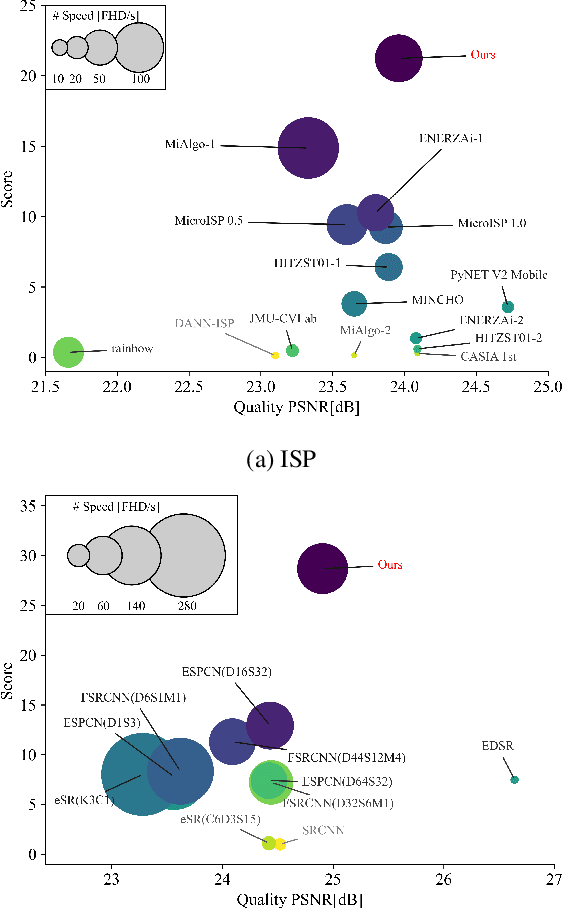
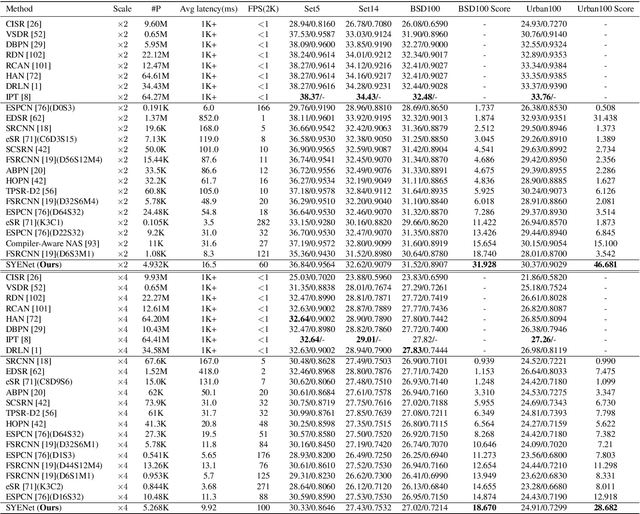
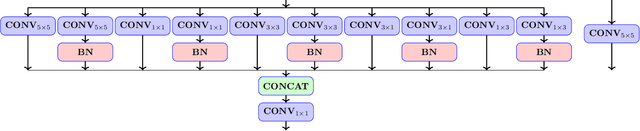
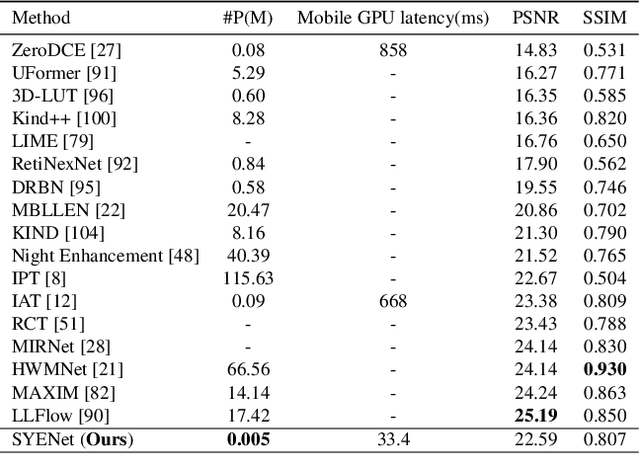
With the rapid development of AI hardware accelerators, applying deep learning-based algorithms to solve various low-level vision tasks on mobile devices has gradually become possible. However, two main problems still need to be solved: task-specific algorithms make it difficult to integrate them into a single neural network architecture, and large amounts of parameters make it difficult to achieve real-time inference. To tackle these problems, we propose a novel network, SYENet, with only $~$6K parameters, to handle multiple low-level vision tasks on mobile devices in a real-time manner. The SYENet consists of two asymmetrical branches with simple building blocks. To effectively connect the results by asymmetrical branches, a Quadratic Connection Unit(QCU) is proposed. Furthermore, to improve performance, a new Outlier-Aware Loss is proposed to process the image. The proposed method proves its superior performance with the best PSNR as compared with other networks in real-time applications such as Image Signal Processing(ISP), Low-Light Enhancement(LLE), and Super-Resolution(SR) with 2K60FPS throughput on Qualcomm 8 Gen 1 mobile SoC(System-on-Chip). Particularly, for ISP task, SYENet got the highest score in MAI 2022 Learned Smartphone ISP challenge.
Learned Smartphone ISP on Mobile GPUs with Deep Learning, Mobile AI & AIM 2022 Challenge: Report
Nov 07, 2022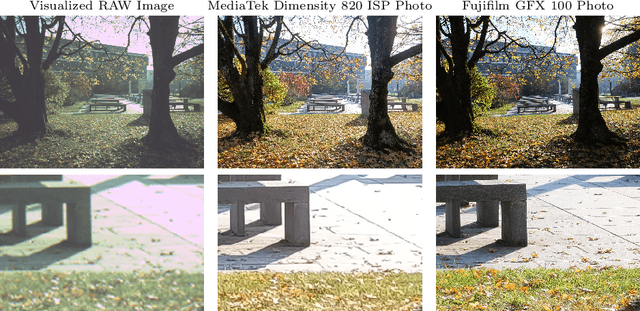
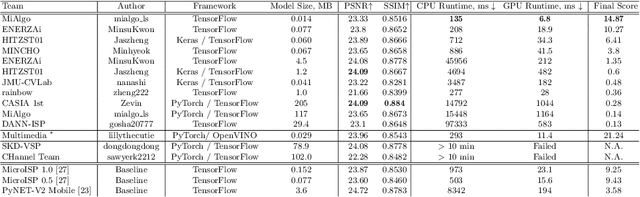
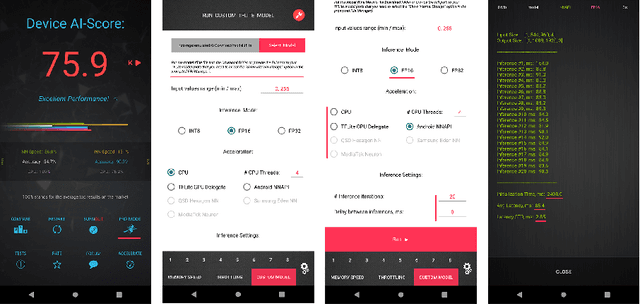
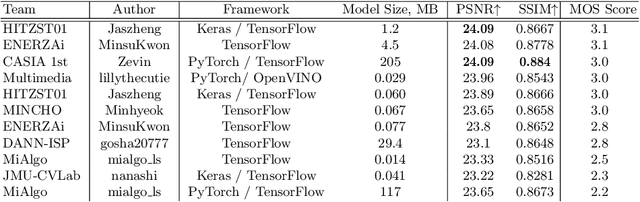
The role of mobile cameras increased dramatically over the past few years, leading to more and more research in automatic image quality enhancement and RAW photo processing. In this Mobile AI challenge, the target was to develop an efficient end-to-end AI-based image signal processing (ISP) pipeline replacing the standard mobile ISPs that can run on modern smartphone GPUs using TensorFlow Lite. The participants were provided with a large-scale Fujifilm UltraISP dataset consisting of thousands of paired photos captured with a normal mobile camera sensor and a professional 102MP medium-format FujiFilm GFX100 camera. The runtime of the resulting models was evaluated on the Snapdragon's 8 Gen 1 GPU that provides excellent acceleration results for the majority of common deep learning ops. The proposed solutions are compatible with all recent mobile GPUs, being able to process Full HD photos in less than 20-50 milliseconds while achieving high fidelity results. A detailed description of all models developed in this challenge is provided in this paper.